


تقديم طلب للحصول على معاش الأرامل والأرامل

Your way to the application
Apply now
لماذا يجب تحديد الموقع؟
بمساعدة معلومات الموقع، يمكننا عرض المعلومات والنماذج والخدمات المناسبة لك ولمكتبك المسؤول.
ما الموقع الذي يجب أن أحدده؟
على سبيل المثال، مكان إقامتك إذا كنت ترغب في تقديم طلب للحصول على جواز سفر أو موقع الشركة إذا كنت ترغب في تسجيل شركة.
- Application for a Survivors' Pension
- Identification document (such as an ID card, passport, birth certificate, or family register)
- Death certificate
- Marriage certificate
- Information about your income
- The deceased’s most recent pension adjustment notice or other pension documents
There are no costs.

Simply explained
The widow’s or widower’s pension provides support in the event of your partner’s death. It can help alleviate the financial hardships often associated with such a loss. The rules apply equally to surviving spouses and registered domestic partners.
A widow’s or widower’s pension is paid from the deceased’s pension account. The amount of your widow’s or widower’s pension depends on this pension account.
During the first three calendar months following the death, your widow’s or widower’s pension is equal to the deceased’s pension (known as the “quarter-year following death”).
Full and Reduced Widow’s Pension
After that, you will receive what is known as the full or reduced widow’s or widower’s pension.
- Full widow’s or widower’s pension: You will receive 55 percent of the pension that the deceased was receiving or would have been receiving at the time of death.
- Reduced widow’s or widower’s pension: You will receive 25 percent of the pension that the deceased was receiving or would have been receiving at the time of death. This pension is generally paid for a maximum of 24 months.
Reductions may lower the amount of the pension paid to you. These reductions depend on how old your spouse was at the time of death. Under certain conditions, you may be eligible for a child supplement.
If you have other income that exceeds a certain exemption amount, part of it will be offset against your widow’s or widower’s pension. The amount of the exemption is calculated on a case-by-case basis. Exception: During the first three calendar months (the quarter following the death), your own income is not taken into account.
Widow’s or Widower’s Pension Under the Old Law
The laws governing the widow’s or widower’s pension were amended starting in 2002. Depending on the date of death and the nature of your marriage or civil partnership, you may be eligible to receive a widow’s or widower’s pension under the old law. The calculation may differ in such cases:
- It is based on 60 percent instead of 55 percent of the deceased’s pension.
- You may also receive the reduced widow’s or widower’s pension indefinitely.
- Fewer types of income are taken into account.
- There is no child supplement.

What requirements must be met?
General Requirements
- You have not remarried.
-
The deceased must have contributed to the pension insurance for at least 5 years (general waiting period) or have already been receiving a pension.
- Exception: If your partner, for example, had a work-related accident, a shorter period may be sufficient.
-
You had been married or in a domestic partnership for at least one year at the time of death.
- Exception: In some cases, it is sufficient if you were married for less than one year. This applies, for example, if your partner died in an accident.
If you remarry, your widow’s or widower’s pension will end. However, you can then apply for a lump-sum payment to help you get started in this new phase of your life.
If you and your partner had decided to split your pension entitlements (pension splitting), you are not eligible to receive a widow’s or widower’s pension.
Small Widow’s or Widower’s Pension
You can receive the reduced widow’s or widower’s pension if
-
you are younger than the current age limit:
- Age limit in the event of death in 2020: 45 years and 9 months
- This age limit will gradually increase to 47 years by 2029.
- you are not partially disabled and
- you are not raising a child under the age of 18.
Full Widow’s or Widower’s Pension
You are eligible for the full widow’s pension if you either
- have reached the current age limit specified above, or
- are disabled, or
- are raising a child of your own or a child of the deceased who is under 18, or
- are caring for a disabled child of your own or a child of the deceased, regardless of the child’s age.
Widow’s or Widower’s Pension Under the Old Law
You may be entitled to a widow’s or widower’s pension under the old law if
- your spouse died before January 1, 2002, or
- you were married before January 1, 2002, and
- your spouse was born before January 2, 1962.
In these cases, you can receive the pension even if you
- were married for less than 1 year.
Widow’s or widower’s pension for spouses who divorced before July 1, 1977
If your marriage ended in divorce before July 1, 1977, you may, under certain conditions, also
- despite having been previously divorced or
- even if you have remarried or entered into a civil partnership that has since been dissolved
be eligible for a special widow’s or widower’s pension.
Widow’s or Widower’s Pension Based on the Penultimate Spouse
You may be eligible for a widow’s or widower’s pension based on the penultimate spouse if you
- remarried or entered into a registered civil partnership after the death of your former partner and
- the new union has since been dissolved or annulled.

Frequently asked questions and answers

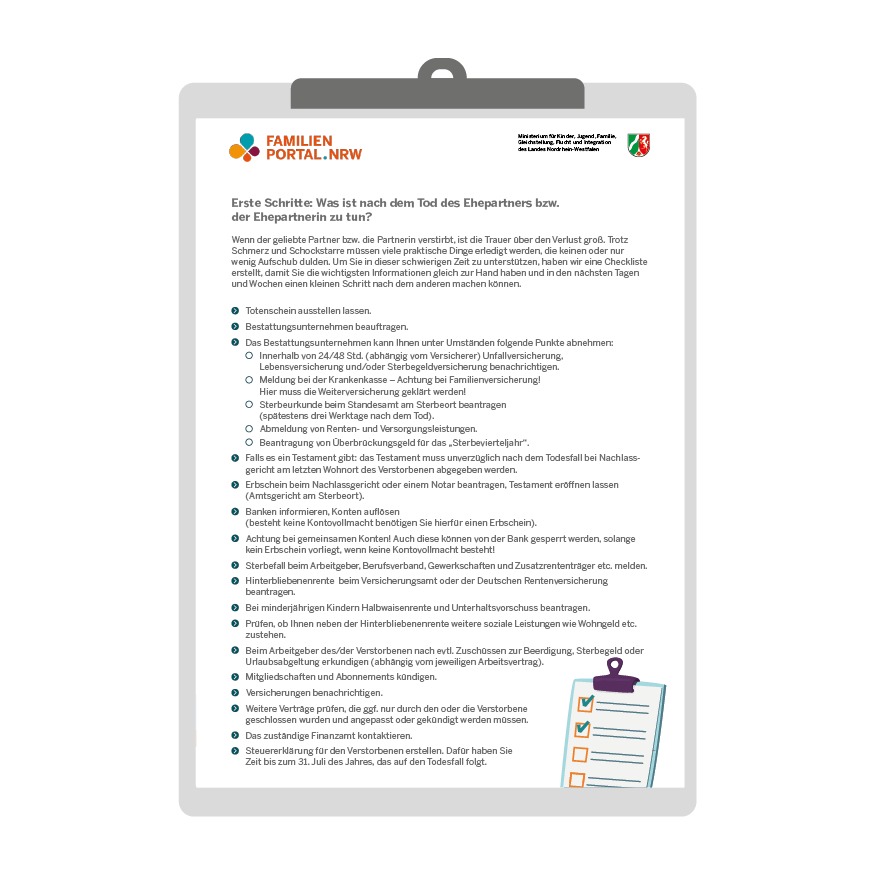
Already checked? Tips and lists for the next steps
Did you already know? More benefits for families