


Demander une pension de veuve ou de veuf

Votre chemin vers l'application
Postuler
Pourquoi dois-je indiquer un lieu ?
Les informations de localisation nous permettent d'afficher les informations, les formulaires et les services qui vous conviennent, ainsi que le service dont vous dépendez.
Quel lieu dois-je indiquer ?
Par exemple, votre lieu de résidence si vous souhaitez demander un passeport ou le lieu d'implantation de votre entreprise si vous souhaitez déclarer un commerce.
- Application for a survivor's pension
- Personal document (such as identity card, passport, birth certificate or family register)
- death certificate
- Marriage certificate
- Details of your income
- Last pension adjustment notification of the deceased or other pension documents
There are no costs.

Explication simple
The widow's or widower's pension supports you in the event of the death of your partner. It can help to cushion the financial hardship often associated with this. The regulations apply equally to surviving spouses and registered partners.
A widow's or widower's pension is paid from the pension account of the deceased. The amount of your widow's or widower's pension depends on this pension account.
In the first three calendar months after death, your widow's or widower's pension is equal to the pension of the deceased (so-called quarter of death).
Large and small widow's pension
You will then receive the so-called large or small widow's or widower's pension.
- Large widow's and widower's pension: You receive 55% of the pension that the deceased was or would have been receiving at the time of death.
- Small widow's and widower's pension: You will receive 25% of the pension that the deceased was or would have been receiving at the time of death. This pension is generally paid for a maximum of 24 months.
The pension paid to you may be lower due to deductions. It depends on how old your partner was. Under certain conditions, you can receive a child supplement.
If you have other income that exceeds a certain allowance, this will be partially offset against your widow's or widower's pension. The amount of the allowance is calculated individually. Exception: In the first three calendar months (quarter of death) after the death, your own income is not taken into account.
Widow's or widower's pension under the old law
The laws governing widow's or widower's pensions were changed from 2002. Depending on the date of death and your marriage or civil partnership, you may be able to receive a widow's or widower's pension under the old law. The calculation may then differ:
- It will be based on 60 percent of the pension of the deceased instead of 55 percent.
- You can also receive the small widow's or widower's pension indefinitely.
- Fewer types of income are taken into account.
- There is no child supplement.

Quelles sont les exigences à respecter ?
General requirements
- You have not remarried.
-
The deceased has paid into the pension insurance scheme for at least 5 years (general waiting period) or has already received a pension.
- Exception: If your partner had an accident at work, for example, shorter periods may be sufficient.
-
You had been married or a partner for at least one year at the time of death.
- Exception: Sometimes it is sufficient if you were married for less than one year. This applies, for example, if your partner has died in an accident.
If you remarry, your widow's or widower's pension will end. However, you can then apply for a settlement to help you start a new chapter in your life.
If you decided as a couple to share your pension entitlements (pension splitting), you cannot receive a widow's or widower's pension.
Small widow's or widower's pension
You can receive a small widow's pension if
-
you are younger than the current age limit:
- Age limit in the event of death in 2020: 45 years and 9 months
- This age limit will gradually increase to 47 by 2029.
- you are not disabled and
- you are not raising a child under the age of 18.
Large widow's or widower's pension
You can receive the large widow's pension if you have either
- have reached the current age limit specified above or
- are incapacitated for work or
- are bringing up your own child or a child of the deceased under the age of 18 or
- are caring for a disabled child of your own or of the deceased, regardless of their age.
Widow's or widower's pension under the old law
You may be entitled to a widow's or widower's pension under the old law if
- your partner died before January 1, 2002 or
- you married before January 1, 2002 and
- your partner was born before January 2, 1962.
In these cases, you can also receive the pension if you
- were married for less than 1 year.
Widow's or widower's pension for spouses divorced before July 1, 1977
If you were divorced before July 1, 1977, you can, under certain conditions
- despite an already divorced marriage or
- a new marriage or civil partnership that has been dissolved again
receive a special widow's or widower's pension.
Widow's or widower's pension after the penultimate spouse
You can receive a so-called widow's or widower's pension after the penultimate spouse if you
- remarried or registered a civil partnership after the death of your former partner and
- the new relationship has now been dissolved or annulled.

Questions fréquemment posées et réponses

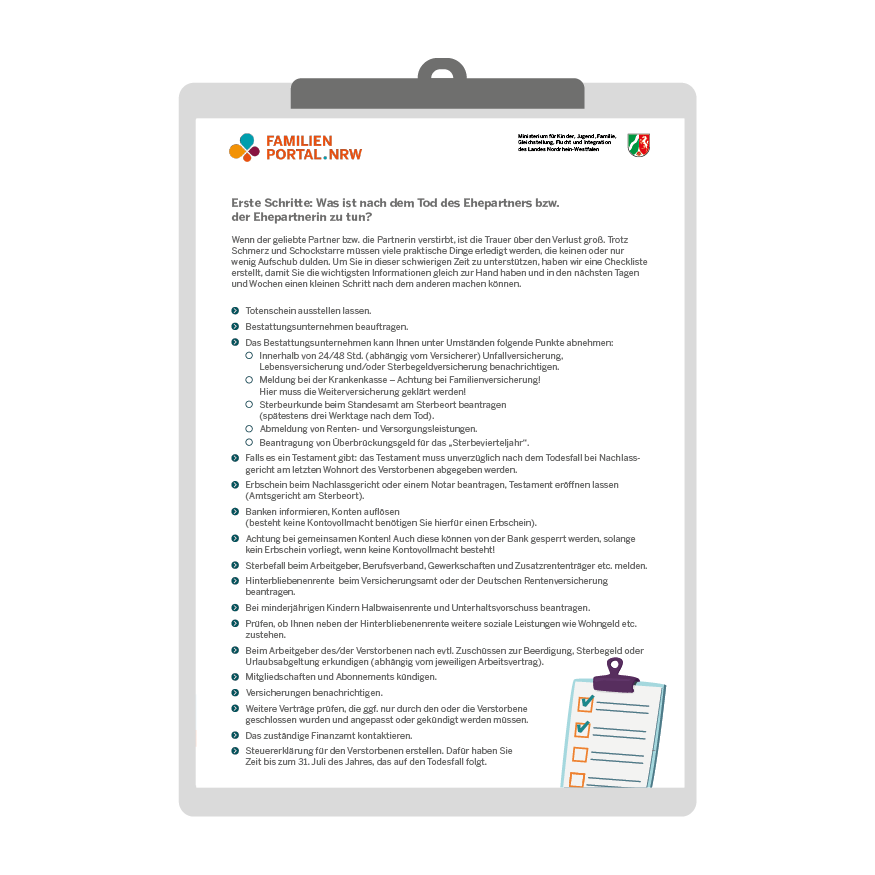
Vous avez déjà vérifié ? Conseils et listes pour les étapes suivantes
Le saviez-vous déjà ? Plus d'avantages pour les familles