

Training for the Walk to School
An Overview of the Most Important Points About School Route Training
- Walking to school promotes physical activity, concentration, and independence, and helps your child navigate traffic safely.
- The best choice isn’t the shortest route, but a route with reduced traffic and as few hazards as possible. Also, be sure to allow plenty of time.
- Practice the route to school regularly together before your child starts school—ideally during the actual school commute times and in both directions.
- Practice with your child, in particular, how to safely cross streets at traffic lights and crosswalks, as well as how to behave properly at bus stops.
- During the first few weeks of school, you should continue to accompany and supervise your child until they can navigate the route with increasing confidence and independence. The walk to school is often easier to manage when your child is with other children.
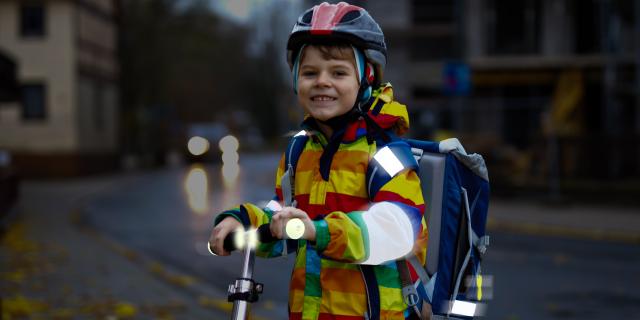
- Ensure good visibility: Especially during the darker months of the year, bright clothing, reflectors on the backpack, and high-visibility vests or safety collars help ensure your child is easily seen.
How can we make the walk to school safer?
Is your child about to start school? If so, you’re probably already thinking about how your child will get to school. There are good reasons to walk. Here’s what you can do to make sure your child arrives safely at elementary school.


Walking to school instead of riding in the parents' car?
If your child attends elementary school in your neighborhood, the walk is often not very far. If your daughter or son can easily cover the distance on foot, this has many advantages:
- If your child walks to school in the morning, it promotes physical and mental development.
- The fresh air boosts their health, and your child arrives at school wide awake.
- The exercise improves their performance and concentration.
- Your child learns early on how to navigate traffic independently and safely.
- Your child learns to navigate and consciously take in their surroundings.
- Your child meets classmates and can make friends.
- Managing the walk to school builds self-confidence.
- Walking instead of driving helps protect the environment and the climate.
Which route to school is the best?
Before you start practicing the route to school with your child, you should choose the right route. Don’t just choose the shortest route; instead, opt for a route with limited traffic and as few hazards as possible. It’s okay to take a slight detour to ensure safety. Your child’s elementary school may even provide school route maps to help you make this decision. Allow plenty of time for the walk to school right from the start. Your child should leave early enough so they don’t have to rush to arrive on time. Teach your child to always stick to the agreed-upon route and never take a dangerous shortcut on their own.
When should I start practicing, and how should I go about it?
The same applies to the walk to school: Practice makes perfect! Once you’ve found the best route, you should practice it with your daughter or son well in advance. It’s best to do this before your child starts school and at the actual times: early in the morning and at noon or in the afternoon, when your child will be walking home. This way, you can explain to your child where they need to be especially careful. Take the time to do this and practice regularly in both directions. With each repetition, your child will become more confident. Observe your child’s behavior and, over time, let them walk ahead more and more independently. This will allow you to assess what your child is already capable of and how they behave. Also let your child walk in a group, since they’ll be walking to school with other children in the future—and children are often more easily distracted when in a group.
Which sections of the road require special attention?
These areas on the road require special attention:
-
Crossing the Street at a Traffic Light
If your child needs to cross the street on the way to school, it’s safest to look for a traffic light. Teach your child the rule: “Stop on red, go on green!”—no matter whether other people ignore this rule. Your child should learn that even at a traffic light, they need to look left and right to make sure the street is clear.
-
Behavior at Crosswalks
If your child is crossing the street at a crosswalk, it’s important to practice this as well: First, stop at the curb and watch for traffic. Your child should raise their arm to signal to drivers. Caution: They should not start walking until the car has actually come to a complete stop. This is important because children are not yet able to accurately judge the speed of vehicles. Once the car has stopped, your child can cross the crosswalk quickly.
-
Danger Zone: Bus Stop
Be careful at the bus stop: If your child takes the bus part of the way, it’s especially important to behave properly at the bus stop. Running toward the bus and pushing to get on are strictly forbidden! Teach your child that after getting off the bus, they must never run in front of or behind the bus, but must wait until the bus has pulled away from the stop and they can see the street clearly.
How long should we walk our child to school?
During the first few weeks after your child starts school, you should still accompany them on their way to school. Perhaps you can take turns with other parents in the neighborhood. Watch from a distance to see how carefully your child behaves in traffic and how they handle dangerous situations. Intervene only when necessary. You’ll see that your child will become more and more confident. Praise your child when they behave correctly in a specific traffic situation.
How safe is the walk to school in the dark?
Especially in the fall and winter, it’s still twilight or dark in the morning when your child walks to school. Make sure your child is clearly visible to other road users. Their backpack should be equipped with enough reflectors. Your child’s clothing should also be light-colored and as reflective as possible. A high-visibility vest or safety collar helps prevent accidents by increasing visibility.
Go alone or with others?
Ideally, your child shouldn’t walk to school alone but should go with other children from the neighborhood. This makes the walk to school even safer. Alternatively, you can organize a so-called “walking bus.” In this arrangement, children who take the same route to school meet at a designated spot nearby. From there, they walk together to the elementary school, accompanied by adults. The chaperones can be parents, senior volunteers, or other trustworthy individuals. Check with the elementary school to see if there is a walking bus.
A Final Tip
Talk to your child regularly about different traffic situations. For example, how they should react if a ball rolls into the street. Or what to keep in mind if they spot a classmate on the other side of the street. Or what to do if the traffic light just turns red: should they stop or run quickly across? Even if your child has been walking to school on their own for a while, you should check in with them from time to time to find out what they’ve experienced along the way. As parents, keep in mind that you serve as important role models when it comes to road safety. Children imitate what they see their parents do.
You Might Also Be Interested In

More Information Links for Further Reading

Tips Download

